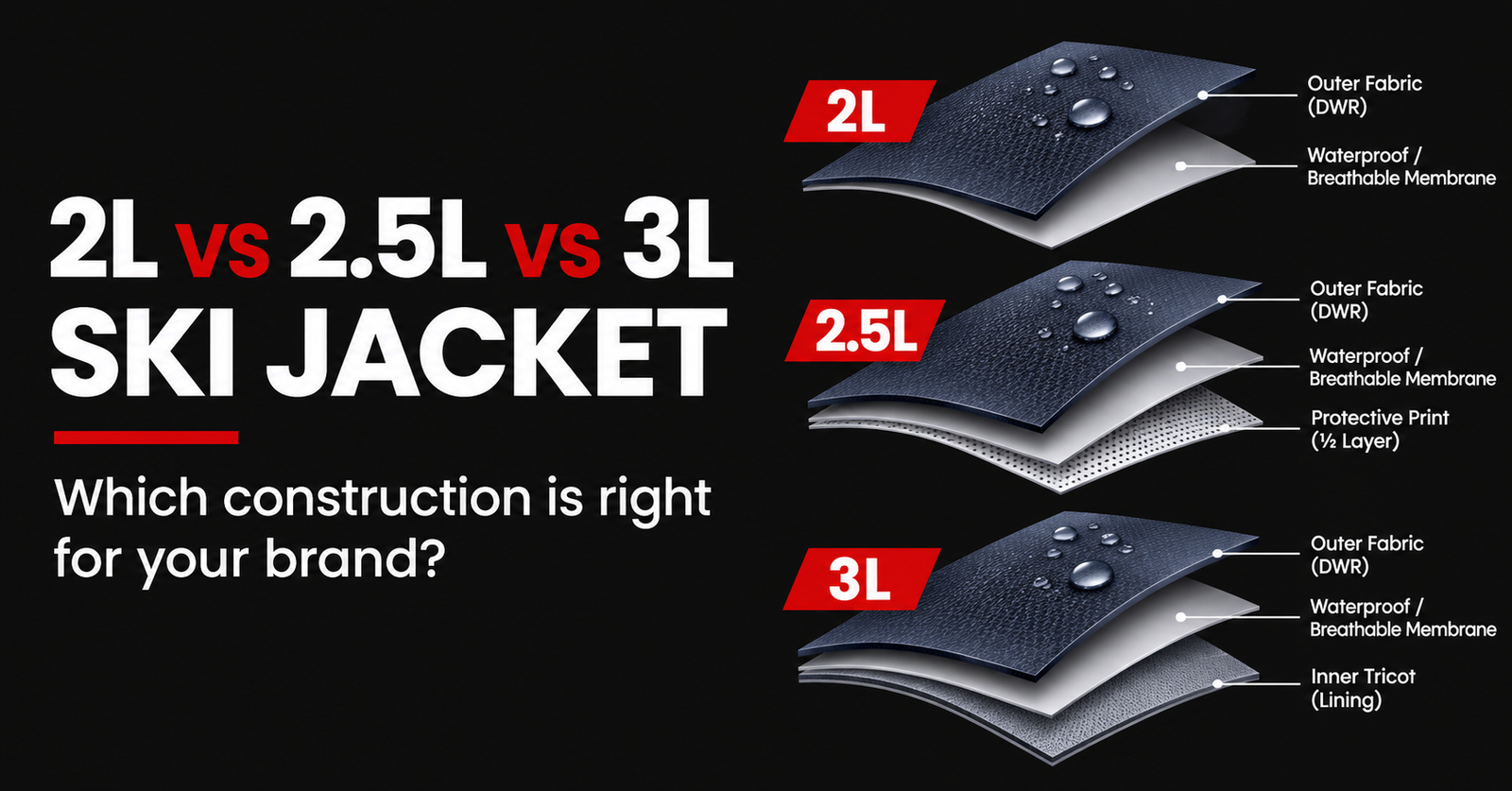
Most founders ask for a 3L shell in their very first message. Honestly, about half of them should not be making one. The 2L vs 2.5L vs 3L ski jacket decision has nothing to do with which construction is “best”. It comes down to the jacket you are actually selling, the price your customer will pay and how that customer rides.
This guide explains what each construction is, how it changes the way a jacket is cut, sewn and taped, and which one a startup ski brand should put into its first sample.
What 2L, 2.5L and 3L Mean in Ski Jacket Manufacturing
Every waterproof ski jacket has a membrane or coating doing the real work. It might be a PU membrane, an ePTFE membrane or a PU coating. The “L” number only tells you how that fragile layer is protected. It is not a waterproof rating and it is not a quality grade.
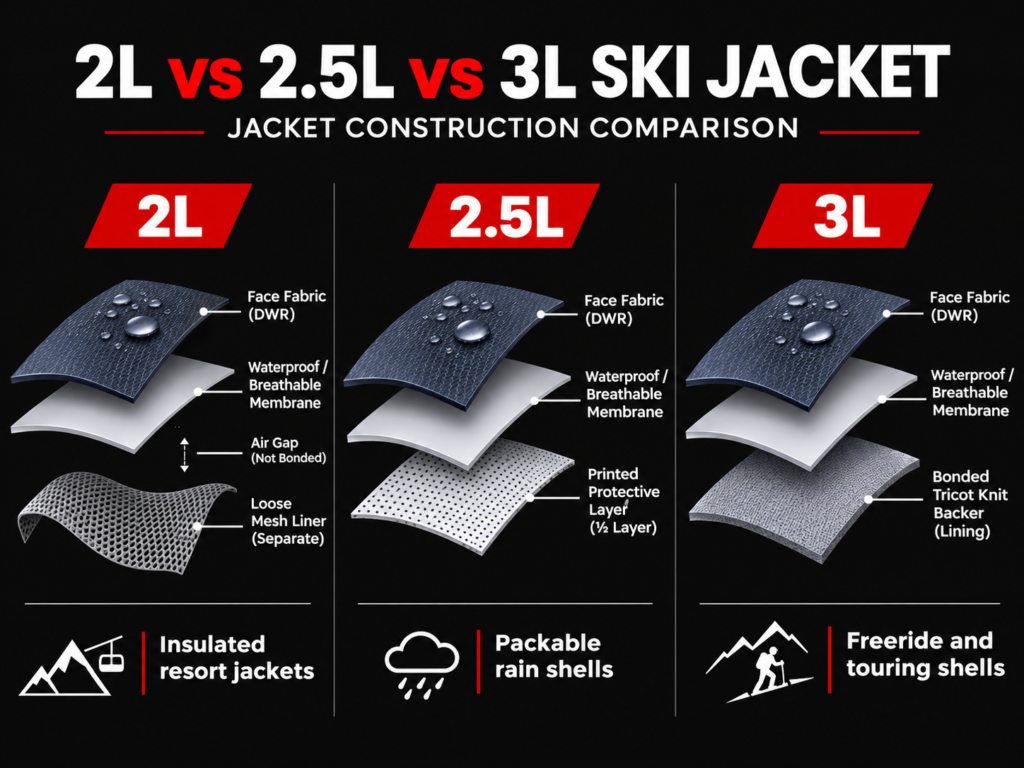
2L (two-layer) construction
The face fabric, usually a 75D to 150D polyester or nylon, is laminated to a membrane. The inside of the membrane stays exposed, so the jacket needs a separate hanging liner: mesh, taffeta, or insulation with a lining over it. The shell is seam taped first, then the liner is sewn in behind it.
2.5L construction
Same face and membrane, but instead of a third fabric there is a thin protective print or coating on the inside, often a dot or carbon-texture pattern. It is light, it packs small and it is cheap. It also feels clammy against skin, and that printed half layer wears away where pack straps and hip belts rub.
3L (three-layer) construction
The membrane is sandwiched between the face fabric and a bonded knit backer, usually a light tricot. No liner is needed because the backer protects the membrane. The fabric is stiffer, heavier per metre and more durable, and it is the hardest of the three to sew and tape well.
2L vs 2.5L vs 3L Ski Jacket: Side-by-Side Comparison
| 2L | 2.5L | 3L | |
|---|---|---|---|
| Build | Face + membrane + loose liner | Face + membrane + printed layer | Face + membrane + bonded backer |
| Typical fabric weight | 120–180 gsm (before liner) | 90–130 gsm | 150–250 gsm |
| Common waterproof spec | 10,000–20,000 mm | 10,000–20,000 mm | 20,000–30,000 mm |
| Durability | Good, liner takes the wear | Lowest | Highest |
| Feel inside | Soft and warm | Thin, slightly sticky | Crisp and technical |
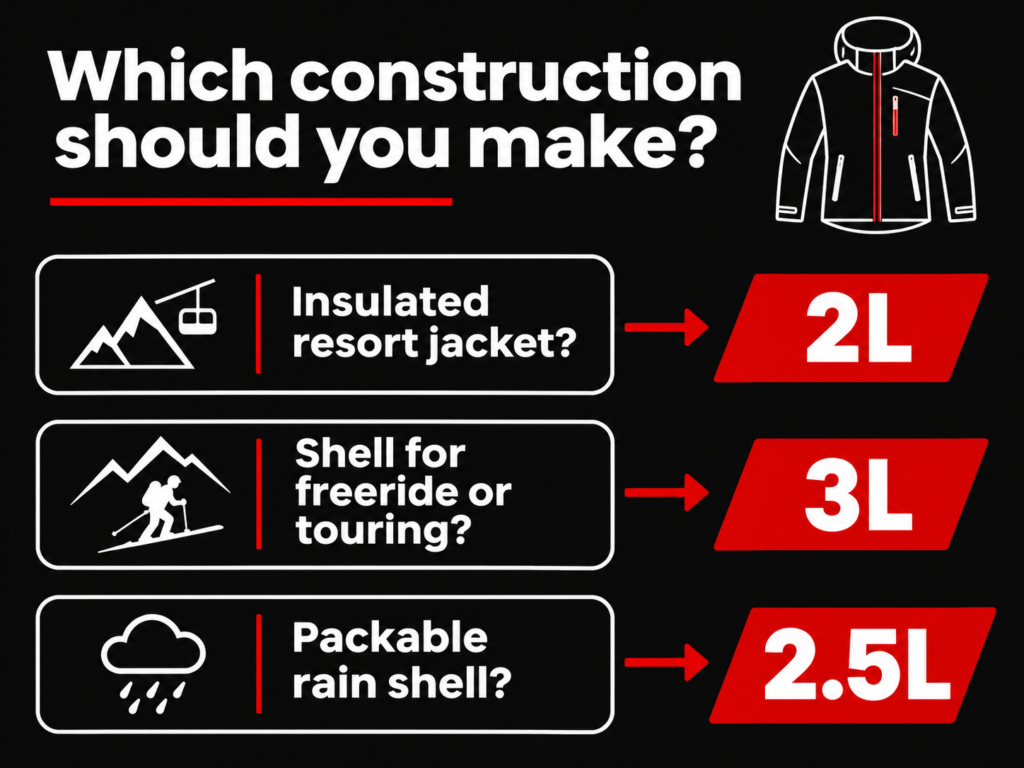
| Best for | Insulated resort jackets | Packable rain shells | Freeride and touring shells |
| Fabric cost | Low to mid | Lowest | Highest |
The ratings above are what brands commonly spec, not hard limits. You can buy a 2L fabric rated at 20,000 mm. What you cannot do is make a 2.5L fabric survive a full season under a backpack.
Waterproof figures come from a hydrostatic head test such as ISO 811, so always ask which test method a mill used before you compare two numbers.
Which Construction Is Right for a Startup Ski Brand?
Here is the misconception I push back on most often: “3L is the premium option, so my brand should use it.” Put 120 g synthetic insulation inside a 3L shell and you have paid for a bonded backer that nobody sees, added weight, and stiffened the jacket. Most insulated ski jackets on resort slopes are 2L for good reason. The liner is already there to hold the insulation, so a third layer adds cost without adding much.
Make a 2L jacket if…
You are selling an insulated resort jacket, your customer skis lift-served terrain, and your retail price sits in the mid range. Most brands I’ve worked with launch with a 2L insulated jacket because it is warm, comfortable on the inside and forgiving to produce.
Make a 3L jacket if…
You are selling a shell. Freeride, backcountry, touring, or a premium baggy snowboard shell that people layer underneath. Here the customer is sweating on the skin track and wearing a pack, so durability and breathability matter more than a soft inside. A 3L shell at 20,000 mm / 20,000 g is a sensible starting spec for most startup shells.
Skip 2.5L for ski jackets
Do not make a 2.5L ski jacket just to hit a price point. I’ve seen brands do it, and the complaints come back the same way: wear at the shoulders, a damp feeling inside, and a jacket that looks tired after one season. 2.5L belongs in an emergency rain shell that lives in a backpack, not in a garment that sees chairlifts and ski edges.
What about snowboard brands?
Baggy snowboard jackets follow the same rule. Insulated or mesh-lined streetwear style? 2L. A technical shell for riders who hike for their lines? 3L. In my experience, snowboard customers notice fit and print long before they notice construction, so do not overspend on fabric and underspend on pattern work.
How Construction Changes the Manufacturing Process
This is the part most founders never hear about, and it affects your sample quality more than the fabric spec sheet does.
Seam taping
Seam tape has to match the inside surface of the fabric. On 3L, the tape bonds to the tricot backer. On 2L, it bonds directly to the membrane. On 2.5L, it bonds to the printed layer, and adhesion varies a lot between fabrics, so it needs testing on every new fabric. Most factories run 20 to 22 mm tape on ski jackets, going wider on bulky seams where several layers of fabric overlap.
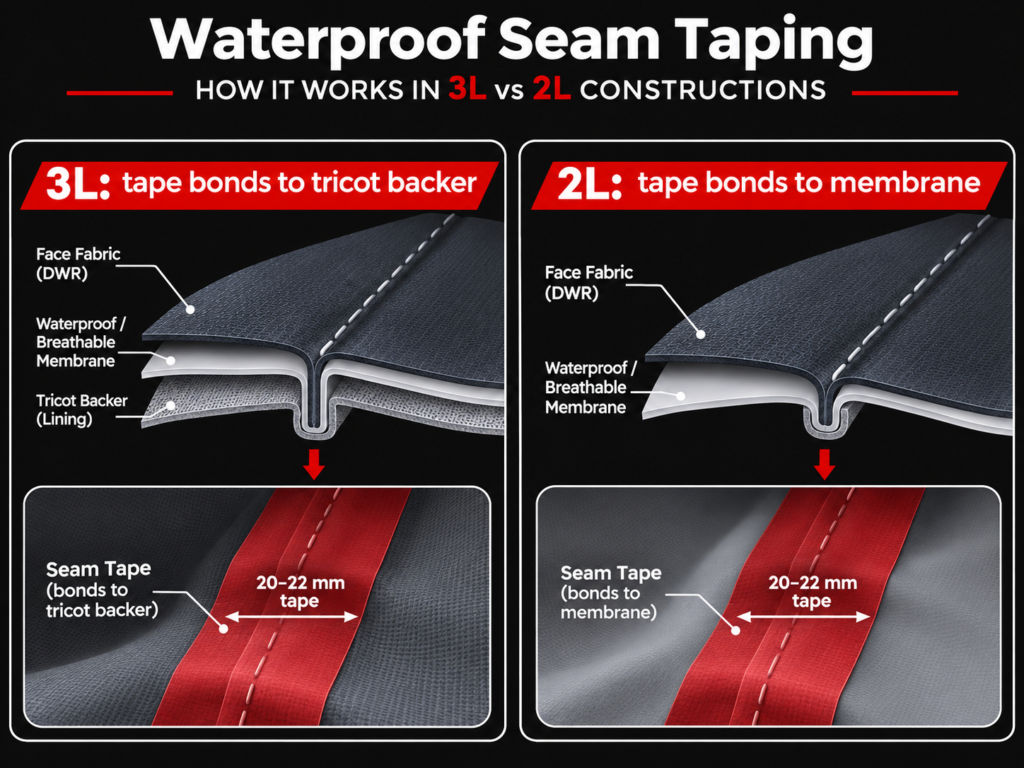
Fully taped versus critically taped is a separate decision. For a ski jacket, specify fully taped. Critically taped (shoulders, hood and upper body only) saves a little labour, but ski jackets take snow from every direction, including when you fall.
Liners and pattern pieces
A 2L jacket is really two jackets: the taped shell and the liner inside it. That means more pattern pieces, more cutting and more sewing time. This is why a well-built 2L insulated jacket often ends up costing close to a 3L shell once labour is counted.
What to put in your tech pack
Whatever construction you pick, your tech pack and sample development brief should state:
- Construction: 2L, 2.5L or 3L
- Membrane type: PU or ePTFE (or “laminated membrane, factory to propose”)
- Waterproof and breathability targets, for example 20K/20K
- Face fabric denier and finish, plus DWR type (ask for PFC-free)
- Seam taping: fully taped, tape width
- Liner or insulation type and weight (for 2L)
- Zippers: water-resistant main zip, or a standard zip with storm flap
Leave any of these blank and the factory will fill the gap with whatever is in stock.
Cost, MOQ and Lead Time for Each Construction
The truth is that 3L fabric costs noticeably more per metre than a comparable 2L, but the gap on the finished jacket shrinks once a 2L gets its liner, insulation and extra sewing. Choosing between a shell and an insulated jacket moves your cost more than the layer count does.
The bigger problem for startups is fabric MOQ. Branded membranes like Gore-Tex usually come with large mill minimums. At BLACKFORGEX we only use Gore-Tex on orders of 500 pieces and above. For smaller runs we use laminated membrane fabrics in 2L and 3L, which give startups real waterproof performance without buying hundreds of metres they will never use.
What to expect when you work with us as your ski wear manufacturer:
- MOQ: 10 pieces per style, per colour
- Sample: 3 to 7 working days, fabric swatches included in the sample parcel
- Sample cost: deducted from your bulk invoice
- Bulk: around 14 working days from sample approval to your door, DDP
- Certificates: provided at bulk stage, on the exact fabric and colour you order
Bulk fabric is ordered after the sample is confirmed and paid, so you never commit to fabric before you have held the jacket in your hands.
Frequently Asked Questions
Is a 3L ski jacket always better than a 2L?
No. 3L is more durable and breathes better as a shell, but for an insulated resort jacket a 2L with a liner is warmer, softer inside and usually better value. Match the construction to the use.
Is 2.5L good enough for a ski jacket?
Not in our view. 2.5L is light and cheap, but the printed inner layer wears under packs and feels clammy. Use it for packable rain shells, not skiwear.
What waterproof rating should a ski jacket have?
Most brands spec 10,000 to 20,000 mm for resort jackets and 20,000 mm or higher for technical shells. Ask which test method was used before comparing numbers.
Can I make an insulated 3L ski jacket?
Yes, but it adds cost and stiffness. Most brands get a better product from a 2L shell with insulation, or a 3L shell sold alongside a separate insulated mid layer.
Do I need Gore-Tex for my first ski jacket collection?
No. Laminated membrane fabrics give strong waterproof performance at startup quantities. BLACKFORGEX offers Gore-Tex from 500 pieces per order.
What is the MOQ for a custom ski jacket at BLACKFORGEX?
10 pieces per style, per colour. Samples take 3 to 7 working days, and bulk takes around 14 working days DDP after sample approval.
Still not sure which way to go? send us your brief with the jacket you want to sell and the price you want to sell it at. That tells us more about the right construction than any spec sheet. For more on fabrics and taping, see our page on waterproof jacket manufacturing.
Ready to manufacture your ski jacket? Send us your tech pack or brief at sales@blackforgex.com or WhatsApp us at +1 405 759 9666. Sample in 3–7 working days. MOQ from 10 pieces.
