Every ski jacket hangtag shows a number like 10K or 20K, and most brand founders copy whatever number their competitor uses. That is a mistake. A ski jacket waterproof rating tells you one specific thing about the fabric, and if you don’t understand what it leaves out, you can launch a 30K jacket that still comes back wet. As a ski jacket manufacturer, this is the question we get most often from new brands, so here is the straight explanation.
Here is the short answer. 10K suits dry resort snow, 15K to 20K covers most resort skiing and snowboarding, and 30K+ is for backcountry and wet climates. For most startup ski brands, a 20K/20K laminated fabric with fully taped seams is the right first spec. BLACKFORGEX manufactures ski jackets in 20K and 30K waterproof fabrics from 10 pieces per style and colour.
What a Ski Jacket Waterproof Rating Actually Measures
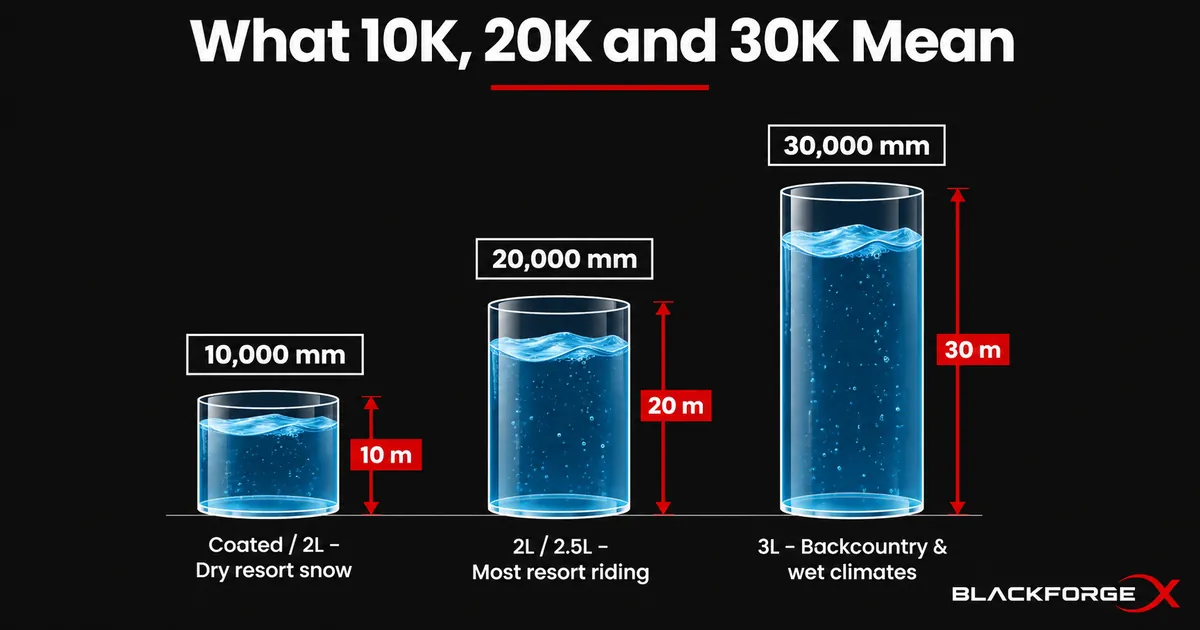
The “K” number is a hydrostatic head reading, measured in millimetres of water. A 10,000 mm (10K) rating means a column of water 10 metres tall can stand on the fabric before water pushes through. A 20K fabric holds a 20 metre column.
That sounds like overkill for snow. It isn’t. The pressure on a jacket isn’t just falling snow. It is your knees on a wet chairlift, your backside on a slushy slope, your shoulders under a pack strap, and wind driving wet snow into the shell for six hours.
How the hydrostatic head test works
A lab clamps a fabric sample under a water chamber and raises the pressure until three drops appear on the face side. The reading at that point is the rating. The common methods are ISO 811 and AATCC 127, and many Asian mills test under JIS L1092.
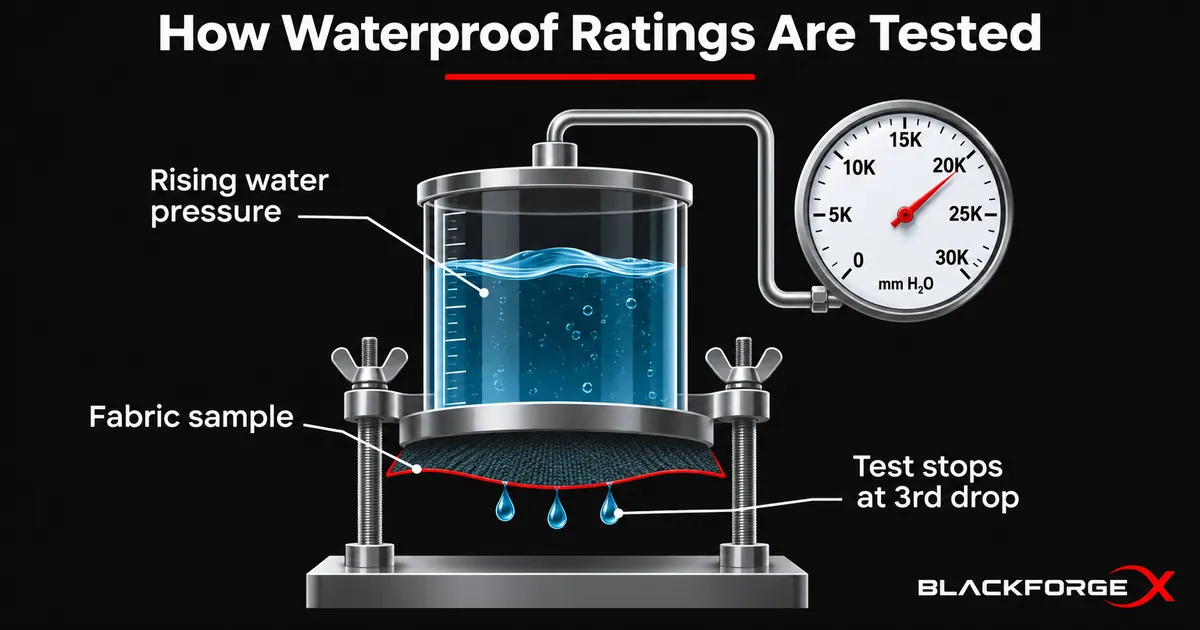
Here is what matters for you: the test is done on new, flat fabric. Not on a sewn jacket. Not after 20 washes. Not on a seam. Keep that in mind, because it is where most of the confusion starts.
The second number: breathability
When you see “20K/20K,” the second number is breathability, usually given as grams of water vapour passing through a square metre of fabric in 24 hours (g/m²/24h). Higher means sweat escapes faster.
Honestly, breathability numbers are messier than waterproof numbers. The JIS L1099 A1 and B1 methods can give very different results on the same fabric, sometimes close to double. A mill quoting 20,000 g on B1 and another quoting 10,000 g on A1 might be selling similar fabric. Serious outdoor brands increasingly use RET (ISO 11092), where lower is better: under 6 is extremely breathable, 6 to 13 is very breathable, and above 20 the wearer will feel clammy on a climb.
If a mill gives you a breathability figure without naming the test method, ask for it. If they can’t tell you, that tells you something too.
10K vs 20K vs 30K: Which Waterproof Rating Do You Need for a Ski Jacket?
10K (10,000 mm)
Fine for cold, dry resort snow and short sessions. This is the entry level for a real ski jacket, usually a PU coated or basic 2L laminated fabric. It works for budget lines, kids’ jackets for occasional trips, and casual après-style pieces.
Where it falls short: wet coastal snow, long days, and anything your customers sit or kneel in.
15K to 20K (15,000 to 20,000 mm)
This is where most serious resort brands should sit. A 20K/20K 2L or 2.5L laminated fabric handles wet snow, chairlift rides and full days on the mountain. In my experience, a well-built 20K jacket with fully taped seams covers the needs of the large majority of resort skiers and snowboarders.
If you are a startup making your first ski collection, this is the range I would spec. It is the best balance of performance, price and fabric availability at low MOQ.
30K and above
This is 3L territory for backcountry, touring and riders in maritime climates like the Pacific Northwest, Japan or Scotland. A 3-layer laminate bonds the face fabric, membrane and inner backer into one sheet, so the membrane is protected and the rating holds up longer.
It costs more, takes more care in production, and the fabric is stiffer. For the full breakdown of constructions, read our guide on 2L vs 2.5L vs 3L ski jacket construction.
Why a Higher Number Doesn’t Always Mean a Drier Jacket
This is the misconception I push back on most often. Founders ask for 30K because it sounds better on a product page. The truth is, the fabric rating is only one part of whether the wearer stays dry.
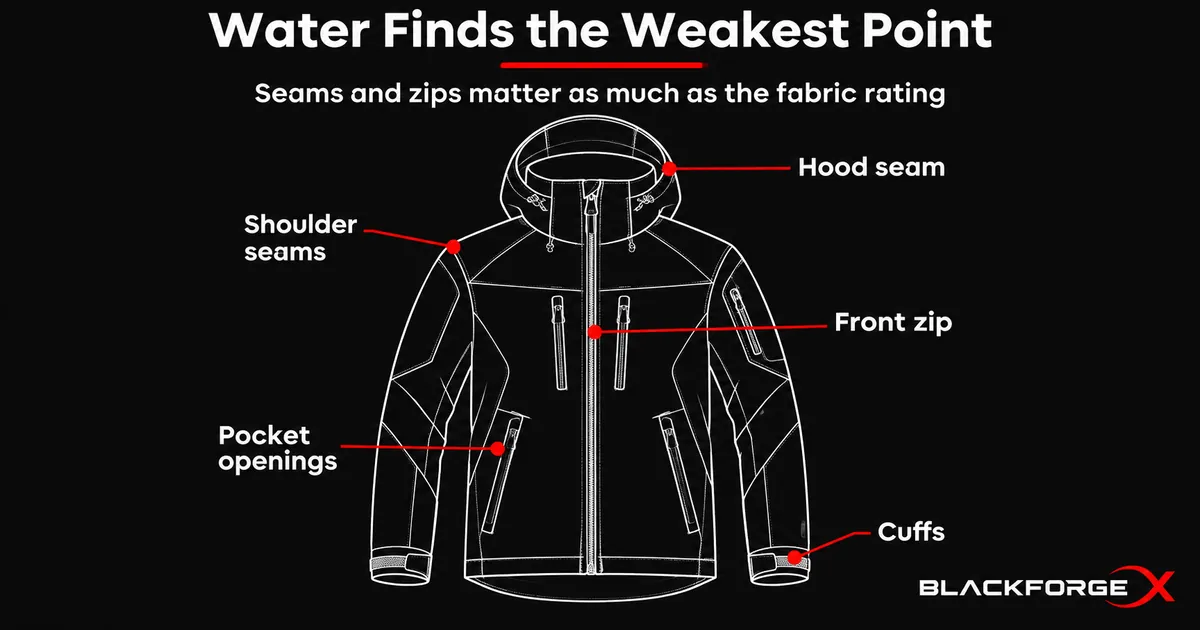
I’ve seen 30K jackets leak through the shoulder seams on day one because the seams were only critically taped. Meanwhile a 15K jacket with every seam fully taped and a proper storm flap kept a rider dry all season. Water finds the weakest point. On most jackets that weak point is a seam, a zip or a pocket opening, not the fabric.
What decides real-world waterproofing:
- Seam taping. Fully taped seams on a waterproof jacket are not optional. Every needle hole is a leak path.
- Zips. Water-resistant coated zips, or a proper storm flap behind a standard zip.
- DWR finish. The outer water repellent makes water bead off. When it wears out, the face fabric wets out, breathability drops, and the wearer feels damp even if no water got through.
- Coating vs laminate. PU coatings lose more of their rating after washing than a good laminate does.
Most brands I’ve worked with get better results spending on construction than chasing a higher number on the fabric.
What Your Ski Jacket Manufacturer Needs in the Tech Pack
When we receive a custom ski jacket tech pack, the waterproof line often just says “waterproof 20K.” That is not enough. Here is what a factory actually needs from you:
- Waterproof rating and test method. Example: “Minimum 20,000 mm, ISO 811.”
- Breathability and test method. Example: “Minimum 15,000 g/m²/24h, JIS L1099 B1” or an RET target.
- Construction. 2L, 2.5L or 3L, and the membrane type (PU, PTFE or similar).
- Seam treatment. Fully taped, with tape width. 20 mm is standard on main seams, narrower on curved areas like hoods.
- DWR type. Specify PFC-free if you sell into the EU or to environmentally aware customers.
- Pants rated higher or equal. Snow pants take more pressure at the seat and knees than any jacket panel. Never spec a lower rating on the pants than the jacket.
If you need help turning your design into a factory-ready spec sheet, our tech pack and sample development service covers fabric ratings, seam specs and trims.
What NOT to do: don’t print a rating on your hangtag that you got from a mill’s sales sheet. Ask for a lab test report on the exact fabric and colour you are buying. At BLACKFORGEX, certificates are provided at the bulk stage on the exact fabric and colour going into your order, not a generic sheet for the base fabric.
Also, don’t ask for Gore-Tex on a first run of 50 jackets. Branded membranes come with high minimums and licensing requirements. We only run Gore-Tex on orders of 500 pieces and above. For startups, a 20K or 30K laminated membrane gives you the performance without locking up your budget.
Waterproof Rating, Cost and Timeline for a Low MOQ Ski Jacket Run
Fabric is normally the biggest single cost on a technical ski jacket. Moving from a 10K coated fabric to a 20K laminate, then to a 3L 30K, raises the fabric cost at each step. Fully taped seams add labour time and tape on top of that.
| Rating | Typical construction | Best for | Relative cost |
|---|---|---|---|
| 10K | PU coated / 2L | Budget lines, dry resort snow | Lowest |
| 15K to 20K | 2L or 2.5L laminate | Most resort brands | Mid |
| 30K+ | 3L laminate | Backcountry, wet climates | Highest |
On timing, our process as a private label ski wear manufacturer looks like this: sample in 3 to 7 working days once the tech pack and fabric are confirmed, then around 14 working days from sample approval to your door, shipped DDP. MOQ is 10 pieces per style and colour, and the sample cost is deducted from your bulk invoice. Fabric swatches come inside the sample parcel so you can feel the hand and check the colour against your spec.
Frequently Asked Questions
What does 20K/20K mean on a ski jacket?
The first 20K is the waterproof rating: the fabric resists a 20,000 mm water column. The second is breathability, about 20,000 grams of vapour per square metre per 24 hours. Always check which test method was used for the breathability number.
Is 10K waterproof enough for skiing?
For cold, dry snow and occasional resort days, yes. For wet snow, long days or riders who sit on the slope, 15K to 20K is a safer baseline.
Do ski pants need a higher waterproof rating than jackets?
They should be at least equal, and ideally higher. The seat and knees take more pressure than any jacket panel when riders sit on lifts or kneel in snow.
Does a ski jacket waterproof rating drop after washing?
Yes, especially on PU coated fabrics. Laminates hold up better and 3L holds up best. Washing with a technical wash and reapplying DWR helps keep performance.
Is 30K better than 20K?
On paper, yes. In practice, a 20K jacket with fully taped seams and good zips often outperforms a 30K jacket with weak construction. Spec the whole garment, not just the number.
Can a manufacturer make 20K ski jackets at low MOQ?
Yes. BLACKFORGEX produces ski jackets in 20K and 30K laminated fabrics from 10 pieces per style and colour, with samples in 3 to 7 working days.
A waterproof rating is a starting point, not a guarantee. Pick the number that matches where your customers actually ride, then put your money into seams, zips and a proper DWR. That is what keeps them coming back for your second collection. If you are making snowboard outerwear too, see our guide on shell vs insulated snowboard jackets.
Ready to manufacture your ski jackets? Send us your tech pack or brief at sales@blackforgex.com or WhatsApp us at +1 405 759 9666. Sample in 3–7 working days. MOQ from 10 pieces. You can also reach us through our contact page.
